Friday, March 23, 2012

Pharmaceutical Quality by Design: Review of Progress and Challenges

This presentation was posted recently by Ajaz Hussain on slideshare and to some groups on LinkedIn.  It contains lots of links to useful content on QbD.

There are some nice references to 'making science visible' and that brings to mind a problem the industry needs to stay on top of.


In a competitive workplace environment where people are rewarded for appearing to be better than / outdo their colleagues, the kind of information sharing that leads to good scientific outcomes could be hard to achieve.  If the reward system is based on metrics like how many experiments are done, rather than how much has been learned, a lower standard of work, favoring quantity over quality, may be the result.

These are problems that managers, especially senior managers can limit, so that 'teams' really operate as teams and that data may be questioned in the interest of gaining further valuable knowledge.  When oversights or mistakes are found, these should be celebrated (in a way) if the resulting lessons are learned and the team moves forward with greater knowledge and improved methods.

So for example as often happens in our work, when a DynoChem model indicates there may be an inconsistency in HPLC data, the team needs to be open to question these data.  It is not enough to say 'I measured it, don't question it'; we also need to ask 'how did you measure it?' and keep going down this track until we know we can trust the data.

Managers can help to ensure that this open environment for genuine teamwork and good science is nurtured.


Thursday, March 15, 2012

Wilfried Hoffmann talks about the use of DynoChem in processdevelopment.


See the full version at http://dcresources.scale-up.com.

Monday, March 5, 2012

Sunday, March 4, 2012

Wilfried Hoffmann's recent book chapter on use of modelling to develop process understanding

Here is a link to a recent book chapter written by Wilfried Hoffmann, now Principal Consultant with Scale-up Systems.

It's all about how a model containing the fundamental rate equations describing chemical composition, temperature and other process responses enables an enhanced approach to process development and especially how process understanding and predictability can be attained with a few well designed experiments alongside the model.

Wilfried is running webinars on this topic for the next 8-10 weeks. You can register here.

Friday, February 24, 2012

Population balance models - watch this space

Chemical development, scale-up, QbD and so on are a serious business but there are also opportunities for humour.  I made up a joke some years ago that I will now share with you loyal readers - it went down much better than expected when aired a few times recently, so here goes.

A crystallization probe [of well known brand that measures chord length distribution in situ] walks into a bar and asks for a drink.  "Would you like that in a bottle or a glass", asks the barman.  "I don't know", says the probe.  "I can't tell the difference."

Which brings us to the subject of today's post.  Chord length (CLD) is related to but not the same as particle size (PSD).  When building models for size, it's attractive to use CLD to estimate kinetics and we provide tools for academic users to do exactly this - their industry counterparts usually do not have time for this and solve practical problems readily through a  good understanding of the mass and energy balance (solubility, volume, composition, supersaturation, temperature).  This has been the topic of some previous posts.

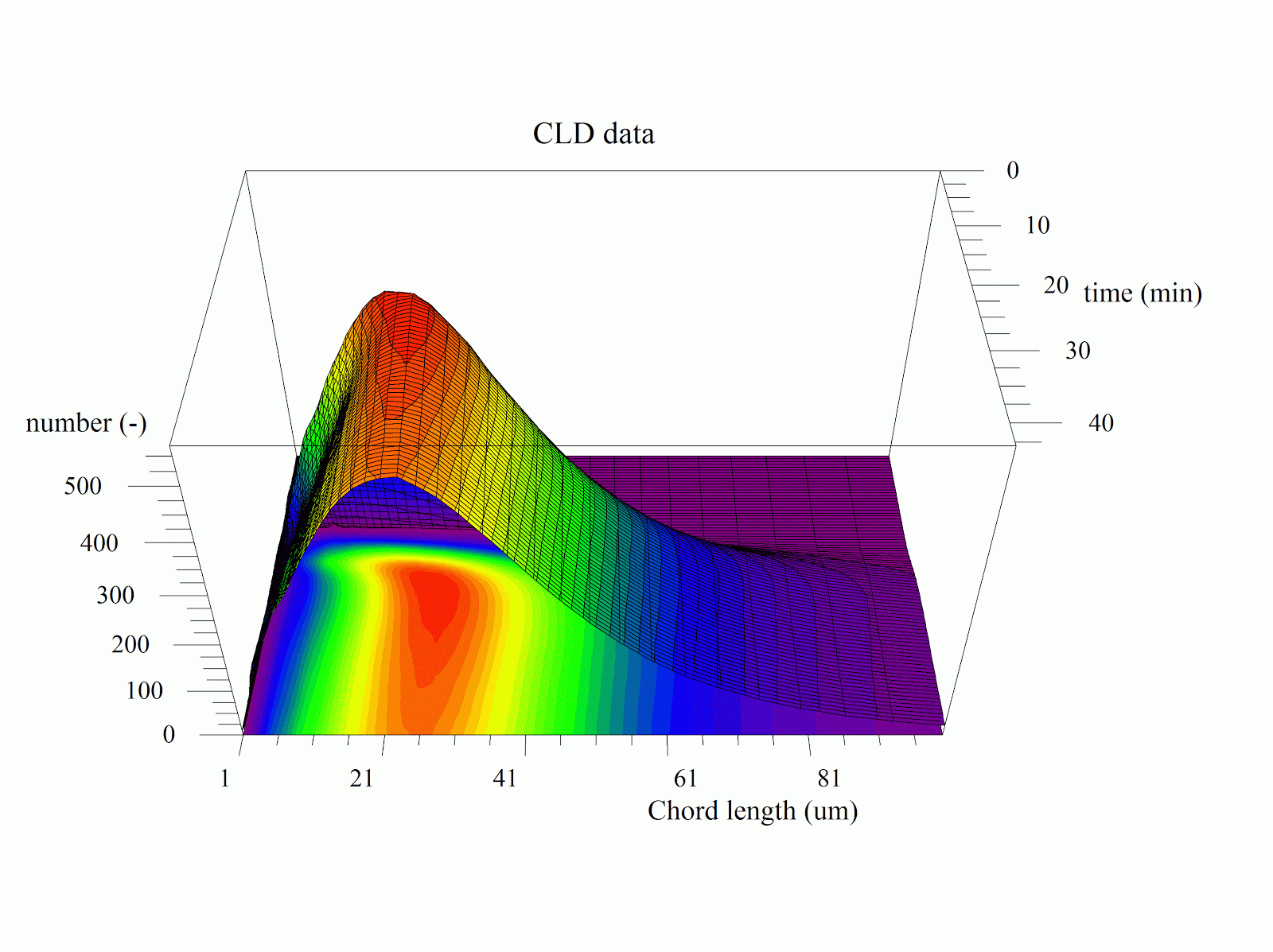
I understand that CLD instrument vendors continue to make improvements in hardware and signal processing.  We have been busy too, exploring the boundaries of what can be done with these data, especially where the capabilities can be incorporated in fit for purpose tools for everyday use by practitioners.  The plots below shows a few results from our newest DynoChem templates and these will be available shortly with supporting guidance in our DynoChem Resources website.  We intend that our academic users find these helpful to progress their research.

Figure 1: Oscillations in CLD as a CSTR crystallizer reaches steady state.  Taken from a DynoChem template using the standard method of moments.


Figure 2: DynoChem moving sectional population balance model for an unseeded batch crystallization (50 size classes).

 
Figure 3: DynoChem conventional population balance model for an unseeded batch crystallization (50 size classes).

 
Figure 4: Lasentec FBRM chord length distribution for an unseeded batch crystallization.

Tuesday, February 21, 2012

Helping chemists focus on chemistry: webinar recording now available

Our Principal Consultant Wilfried Hoffmann recently delivered an excellent webinar on "How to model reaction mechanisms in elementary steps and benefit from enhanced mechanistic understanding" and the recording is now available here.

This first webinar is being followed by a series of weekly webinars to help chemists develop the simple model authoring skills needed to characterize and optimise reactions.  You can register for these events here.

The point is that DynoChem's user interface allows chemists to write down their proposed reaction mechanisms in the same way as they ordinarily think about the reactions occurring in elementary steps. 

Importantly, Dr Hoffmann encourages this way of working, instead of assuming a naive and chemically unrealistic rate expression with e.g. fractional reaction orders, which cannot be translated to different scales, operating modes or even properly capture temperature effects.

Monday, January 23, 2012

Nominations for AIChE QbD Awards: 2012 (Pittsburgh) now open at http://bit.ly/QbDNominate

Nominations for the AIChE QbD Awards, to be presented at the 2012 Annual Meeting in Pittsburgh, are now open to all at  http://bit.ly/QbDNominate.

There are three awards:
- Excellence in QbD for Drug Substance, sponsored by DynoChem
- Excellence in QbD for Drug Product, sponsored by Pfizer
- Excellence In Integrated QbD Practice, sponsored by Merck.

Please submit nominations by 11 May 2012. All nominations will be considered by the awards committees.

For information about previous winners, see articles on PharmaQbD.com:
http://www.pharmaqbd.com/aiche_qbd_awards_2011/
http://www.pharmaqbd.com/aiche_awards_seibert_garcia-munoz/

ShareThis small