Chemical development, scale-up, QbD and so on are a serious business but there are also opportunities for humour. I made up a joke some years ago that I will now share with you loyal readers - it went down much better than expected when aired a few times recently, so here goes.
A crystallization probe [of well known brand that measures chord length distribution in situ] walks into a bar and asks for a drink. "Would you like that in a bottle or a glass", asks the barman. "I don't know", says the probe. "I can't tell the difference."
Which brings us to the subject of today's post. Chord length (CLD) is related to but not the same as particle size (PSD). When building models for size, it's attractive to use CLD to estimate kinetics and we provide tools for academic users to do exactly this - their industry counterparts usually do not have time for this and solve practical problems readily through a good understanding of the mass and energy balance (solubility, volume, composition, supersaturation, temperature). This has been the topic of some previous posts.
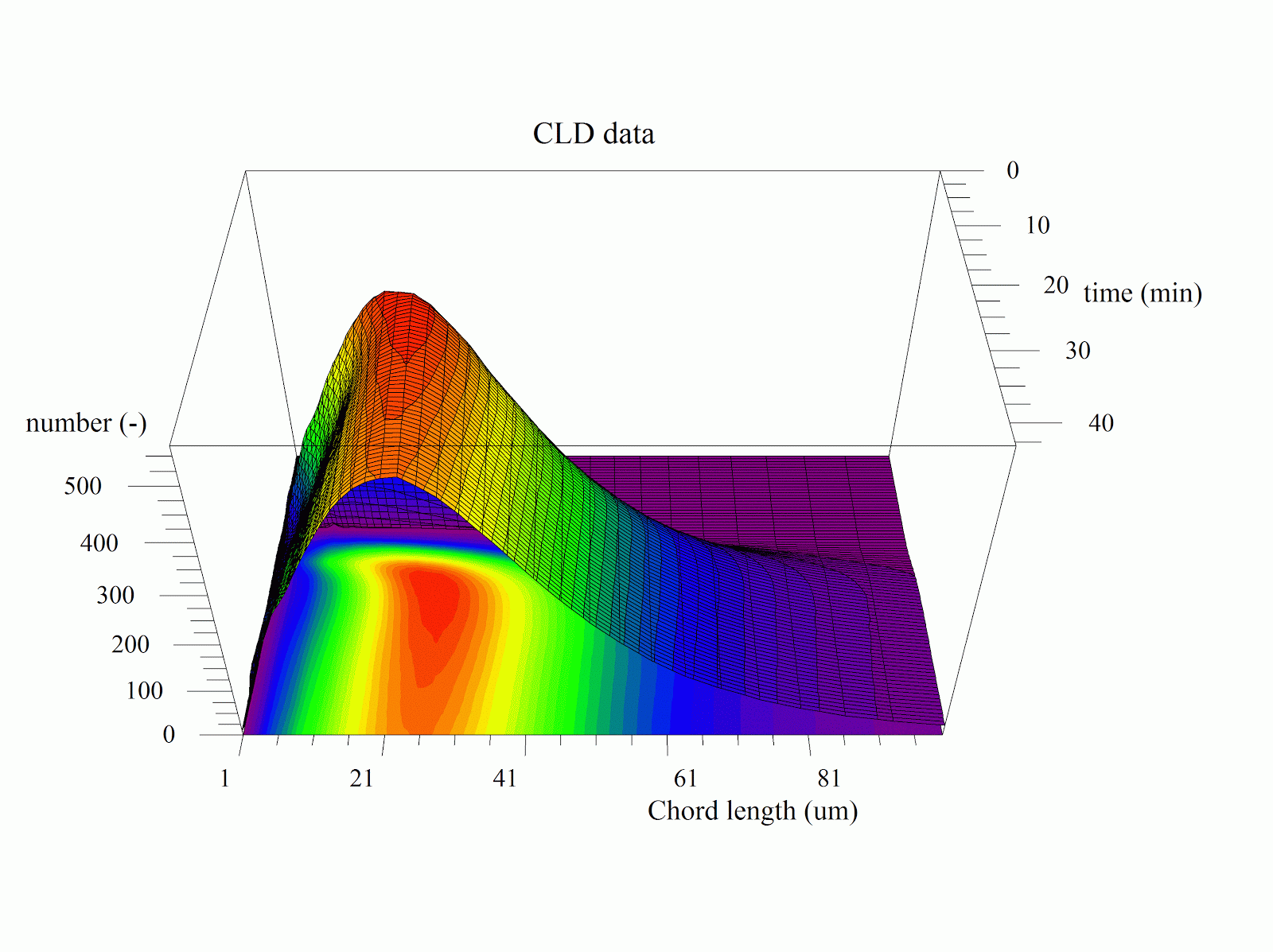
I understand that CLD instrument vendors continue to make improvements in hardware and signal processing. We have been busy too, exploring the boundaries of what can be done with these data, especially where the capabilities can be incorporated in fit for purpose tools for everyday use by practitioners. The plots below shows a few results from our newest DynoChem templates and these will be available shortly with supporting guidance in our DynoChem Resources website. We intend that our academic users find these helpful to progress their research.
 Figure 1: Oscillations in CLD as a CSTR crystallizer reaches steady state. Taken from a DynoChem template using the standard method of moments.

Figure 2: DynoChem moving sectional population balance model for an unseeded batch crystallization (50 size classes).
 Figure 3: DynoChem conventional population balance model for an unseeded batch crystallization (50 size classes).
 Figure 4: Lasentec FBRM chord length distribution for an unseeded batch crystallization.
A crystallization probe [of well known brand that measures chord length distribution in situ] walks into a bar and asks for a drink. "Would you like that in a bottle or a glass", asks the barman. "I don't know", says the probe. "I can't tell the difference."
Which brings us to the subject of today's post. Chord length (CLD) is related to but not the same as particle size (PSD). When building models for size, it's attractive to use CLD to estimate kinetics and we provide tools for academic users to do exactly this - their industry counterparts usually do not have time for this and solve practical problems readily through a good understanding of the mass and energy balance (solubility, volume, composition, supersaturation, temperature). This has been the topic of some previous posts.
I understand that CLD instrument vendors continue to make improvements in hardware and signal processing. We have been busy too, exploring the boundaries of what can be done with these data, especially where the capabilities can be incorporated in fit for purpose tools for everyday use by practitioners. The plots below shows a few results from our newest DynoChem templates and these will be available shortly with supporting guidance in our DynoChem Resources website. We intend that our academic users find these helpful to progress their research.


Figure 2: DynoChem moving sectional population balance model for an unseeded batch crystallization (50 size classes).